
- Browse Categories
- Sea Freight
- Air Freight
- Railway Freight
- FBA Amazon
- Express Service
- Warehouse Service
- Trucking Service
- Custom Clearance
- SOC container shipping
- Contact Us
-
TEL:+86-755-25643417
Fax: +86 755 25431456
Address:Room 806, Block B, Rongde Times Square, Henggang Street, Longgang District, Shenzhen, China
Postcode: 518115
E-mail: logistics@swwlogistics.com.cn Contact Now
- Hot products




- Latest NewsMore>>
-
- The Spring Festival is ahead of schedule and port congestion has not disappeared, and freight forwarders are facing a squeeze on their pre-holiday shipping window.
- Attention: Shenzhen trailers are restricted in large areas, and pick-up and return of containers at the port may be delayed.
- SOC Container Shipping from China to Le Havre France
- The ship had not arrived at the port for more than a month after the fire, and the shipowner declared general average, carrying 2,300 containers of cargo.
- Ocean freight may plummet by 30% in 2027, and the container shipping market may usher in a major reversal
- SOC Container Shipping from China to Canada shipping
- Maersk CEO responds to stock price plunge: Freight prices cannot remain high for a long time
- 20GP SOC Container Shipping from Shanghai China to the UK
- U.S. Customs releases new IOR regulations: Customs clearance of Chinese goods becomes more difficult and will be implemented on January 5, 2027
- 40HQ SOC Shipping Agent from Shenzhen to Germany
- Middle East ports are heavily congested, ships cannot wait for berths, and shipping companies are restricting bookings
- Port of Los Angeles-Long Beach strike risk on hold
- Certifications
-








- Follow us
- Subscribe
-
Get email updates on new products

China to Bahrain Door to Door Air Sea Shipping Service
- Destination:Bahrain
- Departure Day:Bahrain
- Transit Time (Days):35 Days
- Shipment Type:All Types
- Type:Freight Forwarder Sea Cargo
China to Bahrain Door to Door Air Sea Shipping Service
The Short Answer
Bahrain is an island of about 780 square kilometres with fewer than two million people, which makes it the one Gulf market where a forty-foot container of a single product can be months of stock. Importers respond by sharing boxes, and that decision sits upstream of the shipping term: a customs declaration names one importer, so a container divided among three buyers has to be structured before it is booked, not after it arrives. DDP and DDU do not describe who pays so much as which of three sharing models you have chosen.
What a Booking Covers
A door-to-door arrangement runs from your supplier to the Bahraini address: collection, export declaration, the sea, road or air movement, the entry, and the delivery.
On DDP the goods are imported in our name, the duty and the ten per cent VAT are funded by us, and each receiving party gets a delivered invoice. On DDU the consignee is the importer, pays at release, and recovers the VAT through its own return if it is registered.
Three Ways to Share a Box
One consignee, one container
The simplest shape, and the only one where the term is a genuine either-or. A single importer takes the whole container, pays duty and VAT on the entire value, and distributes internally. DDP removes the customs work from its desk; DDU leaves it there.
Several consignees, one co-loaded container
Here the box is consolidated at origin and deconsolidated at a Bahraini warehouse, with a house bill for each buyer. Every buyer clears its own house bill, which means every buyer is an importer for its own share and needs its own registration if it wants the VAT back. DDP can still be offered house by house, but it is three separate undertakings rather than one.
One importer of record, then domestic resale
A single party imports the full container and sells the goods onward inside Bahrain, invoicing at ten per cent VAT. This is the shape most DDP quotations actually use, because it needs one declaration, one duty payment and one VAT recovery. The other buyers buy locally and never touch customs.
What the Split Costs
Duty is five per cent of the CIF value on most goods under the common Gulf tariff, and VAT is ten per cent of the duty-paid amount, collected at clearance on behalf of the National Bureau for Revenue. The VAT is recoverable, but only by a registered business, and registration becomes mandatory at 37,500 dinars of annual supplies and imports, with a voluntary route from 18,750.
The practical consequence is arithmetic. Three small buyers each below the registration threshold cannot recover the VAT on their share, so the tax becomes a permanent cost and the co-loaded model quietly loses money. One registered importer taking the whole box recovers all of it.
How the Box Arrives
By feeder into Khalifa Bin Salman Port. The country's commercial port sits at Hidd, operated by APM Terminals, and most Asia cargo reaches it on a relay from a larger Gulf hub rather than on a direct call. Feeder frequency, not ocean distance, is what sets the week.
By road across the causeway. The King Fahd Causeway runs 25 kilometres to the Saudi mainland, and a container discharged at Dammam can cross by truck. It is often quicker than waiting for the next relay, and it brings its own export and transit formalities on the Saudi side.
By air into Bahrain International. A short hop from Gulf hubs, useful for samples and for the portion of a split consignment that is urgent while the rest is at sea.
What the Clearance Actually Requires
Declarations are lodged through the national single window, and the importer named on them must be locally registered. The document set is the familiar one, with two local habits worth planning for: the invoice has to match the house bill exactly when a container is co-loaded, because the declaration is filed per bill; and the duty and VAT are assessed on the value declared for that share, so an under-declared house bill is a problem for the buyer who filed it and a delay for everyone else in the box.
Why Shippers Route Bahraini Cargo Through Us
Sunny Worldwide Logistics (SZ) Limited has moved freight since 1998 and runs its own trucking company at the Shenzhen sea port, so the container movement from your factory to the terminal is handled by the same team that books the sailing and prepares the Bahraini entry.
Bahrain rewards that because a shared container is a coordination problem before it is a freight problem. The consolidation, the house bills, the deconsolidation and the clearance have to agree on the same quantity, and the party that controls all four can fix a discrepancy before the vessel sails rather than after the box is opened.
Cargo We Move into Bahrain
- Consumer electronics, accessories and small appliances
- Furniture, lighting and home textiles
- Building materials, sanitary ware and hardware
- Industrial spares, pumps and workshop equipment
- Solar components, cables and electrical fittings
- Automotive and motorcycle aftermarket parts
- Retail replenishment stock and e-commerce goods
What We Need Before Booking
- Commercial invoice and packing list per house bill, not only per container
- The number of consignees and the share each one takes
- Whether each consignee is VAT-registered in Bahrain
- Delivery addresses for each share, or a single deconsolidation warehouse
- HS codes for every line, since duty is assessed per share
- Any product approval the category requires before sale
About the Company Filing Your Bahraini Entry
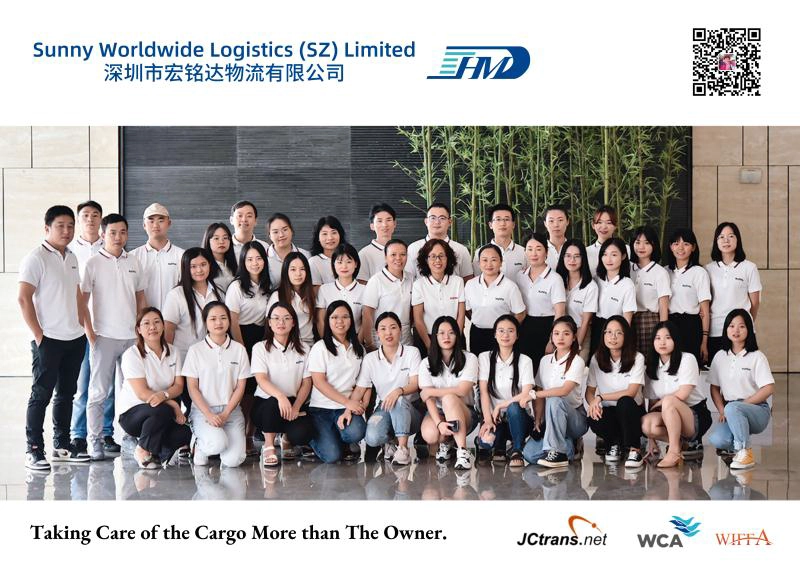
Sunny Worldwide Logistics (SZ) Limited has handled freight since 1998 and works as a full-service domestic and international forwarder based in China. The firm occupies a 1,800 square metre Class A office in Shenzhen and owns its port trucking operation, keeping collection and documentation in one place.
Samira Chen / Sunny Worldwide Logistics (SZ) Limited / 8/F, Block B, Rongde Times Square, Henggang Street, Longgang District, Shenzhen, China / phone and WhatsApp +86 13428330724 / Trade Manager cn220161160 / sales38@swwlogistics.com.cn
Questions Importers Ask About Bahraini DDP
Q: Can one container be declared for three different buyers?
A: Not on one declaration. A container with three consignees is normally co-loaded, with a house bill for each buyer and a separate clearance for each share. One declaration means one importer.
Q: What does the import cost?
A: Five per cent duty on the CIF value for most goods, then 10 per cent VAT on the duty-paid amount. The VAT is recoverable by a registered business; registration is compulsory above 37,500 dinars of annual supplies and imports.
Q: Is it cheaper to truck the goods from Saudi Arabia?
A: Sometimes. The causeway is 25 kilometres and a container discharged at Dammam can cross by road, which often beats waiting for a feeder. The Saudi export and transit paperwork, and the queue at the crossing, are the costs that decide it.
Q: What happens to a buyer below the VAT threshold?
A: The ten per cent becomes a real cost, because there is no registration to recover it against. That is the strongest argument for consolidating several small buyers under one registered importer rather than clearing each share separately.
Q: How long does the whole thing take?
A: Around 22 to 30 days door to door by feeder, 20 to 28 days if the box is trucked from the Saudi side, and 4 to 7 days by air. The relay schedule into Khalifa Bin Salman Port is the variable that moves most.
Q: Do you handle the deconsolidation?
A: We arrange it, and we prepare the house bills so the deconsolidation and the declarations describe the same quantities. Where the split happens in a third-party warehouse, we work to that operator's cut-off.
Get a DDP or DDU Figure for Bahrain
Start with the consignee count. One buyer and four buyers are two different products, and the difference in price comes from the structure rather than from the freight rate.
Send the split, the SKU list and the delivery areas to sales38@swwlogistics.com.cn, or call Samira Chen on +86 13428330724.
Tel:+8613534256934
Wechat:13534256934
Contact Person:Samira

- Other Products