














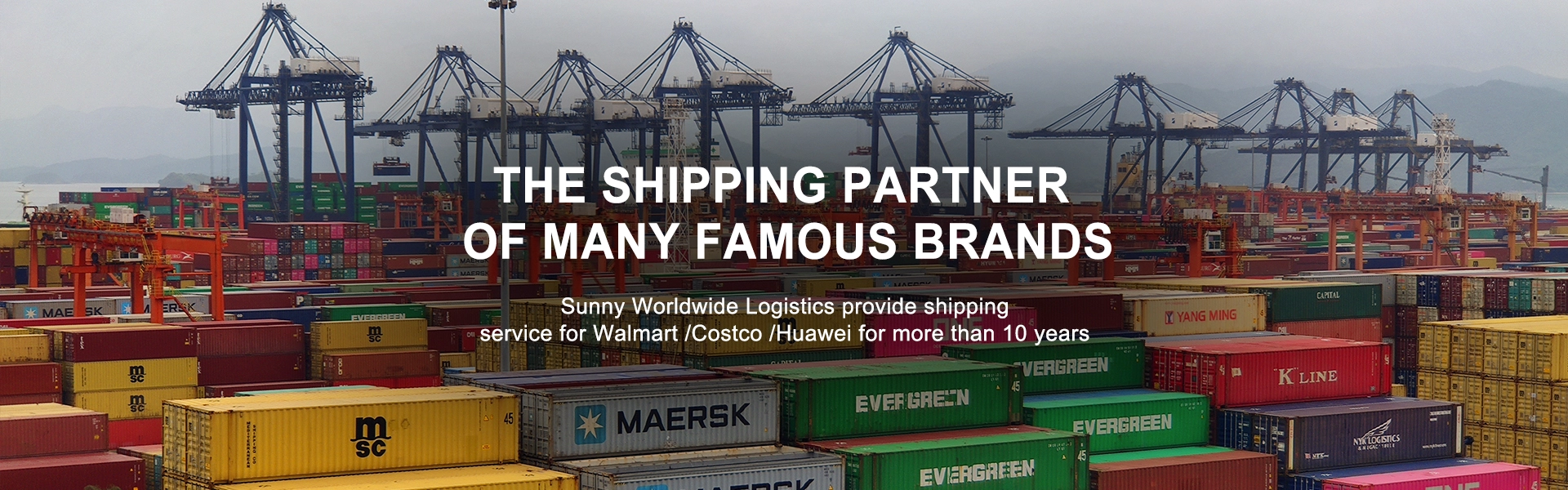

















Container freight prices continue to decline, with major routes generally declining, and the market is waiting for demand to pick up after the year.
Sunny Worldwide LogisticsIt is a logistics company with more than 20 years of transportation experience, focusing on markets such as Europe, the United States, Canada, Australia, and Southeast Asia. It is more of a cargo owner than a cargo owner~

Recently, as the Lunar New Year approaches, the Asian export container shipping market has entered the end of pre-holiday shipments. Affected by this, the market's supply of shipping capacity has become more abundant relative to demand, and freight rates on major routes continue to show an adjustment trend. The latest Shanghai Export Container Freight Index (SCFI) reported 1266.56 points, down 3.81% from the previous week. The index has declined for the fifth consecutive week, and freight rates on the four major ocean trunk routes have generally declined.
Looking at specific routes, the freight rates of all major routes fell to varying degrees: the freight rates of the Far East to the West American route fell by 3.53%, and the freight rates of the East American route fell by 2.88%; the European route fell slightly by 1.06%, the Mediterranean route dropped significantly, to 5.49%; the Southeast Asian route in the near ocean also fell by 4.55%. However, compared with the previous period, the decline of most routes this week has narrowed.
According to feedback from the freight forwarding market, the current spot freight rates are roughly as follows: the US West route is about 1,650-1,750 US dollars per 40-foot container, the US East route is about 2,350-2,500 US dollars, and the European route is about 2,000-2,200 US dollars. The overall price is basically the same as last week. Market analysts believe that the demand for goods before the Spring Festival has been basically released, and the shipping company's flight arrangements are as usual, resulting in oversupply on most routes in February. The overall freight rate is under pressure, mainly weak consolidation.
It is worth noting that the performance of different regional markets diverges. The freight rate on the Japan route has remained stable for several consecutive weeks; the freight rate on the South American west route (Manzanillo) has shown signs of stopping falling and recovering. Industry insiders revealed that some shipping companies are planning to push for a wave of basic freight rate increases in the second half of February, especially on South American routes, where they are planned to increase by hundreds of dollars per 20-foot container. In addition, the last wave of factory shipments before the holiday has provided short-term support to individual routes, but its sustainability remains to be seen.
On the trans-Pacific route, although the overall cargo demand is still weak, freight rates have temporarily maintained a relatively stable pattern due to the efforts of shipping companies to proactively regulate shipping capacity (such as arranging sailing suspensions). Industry views point out that the core purpose of this move is to avoid the market falling into fierce price competition, rather than a substantial improvement in demand.
In the face of weakening demand, shipping companies' defensive attitude towards freight rates is still obvious. Although many major global carriers have tried to increase freight rates since January, due to the peak shipments before the Spring Festival appearing in December last year and market demand weakening after January, there is no sufficient support for the increase in freight rates. For the follow-up market, the industry generally believes that the key lies in the recovery speed of actual cargo volume after the Lunar New Year. Large freight forwarders have pointed out that some shipping companies have proposed a price increase plan on March 1, with the goal of pushing the US west line to US,200/FEU and the US east line to US,000/FEU, but its final implementation still needs to be observed.
Looking forward to the post-holiday period, due to the late Spring Festival this year, factories are generally expected to resume work in early March. Therefore, the substantial recovery of market volume may not gradually become clear until mid-to-late March. There are already signs that long-term contract negotiations between some shipping companies and direct customers of North American routes may be postponed, reflecting that market parties are still cautious about the market outlook.